
Effort versus result in order flow
Effort versus result is a simple question to ask of every push: how much volume did it take, and how far did price move? When the two match, the push is working. When volume is high and the move is small, something is in the way.
The idea
Effort is the aggressive volume behind a move. Result is the distance price travelled. The idea goes back to Richard Wyckoff's work on price and volume, and it carries over well to modern order flow, where you can see each trade and the side that started it.
Three outcomes
Measured against how far a push of that size usually moves price, most pushes end up in one of three places:
- Moving: price travels about as far as the volume suggests. The push is working.
- Stalling: volume is still coming in, but price moves less than it should. The push is meeting resistance.
- Absorbed: a lot of volume and almost no movement. The other side is soaking it up.
Why it helps
Volume alone can mislead you into following a push that is already failing. Price alone hides how hard each side worked for the move. Putting them together shows whether the market is accepting the push or rejecting it, often before a candle makes it obvious.
Keep it in context
Effort versus result describes the push in front of you. It does not predict the next one, and a stalling push can still resume. Readings settle best on a closed candle, and they mean more at a level that matters than in the middle of a range.
How Delphi Pulse shows it
Delphi Pulse shows effort versus result as its push result gauge: Moving, Stalling or Absorbed, naming the side doing the absorbing. Next to it, Fuel compares the pushing side's last 3 seconds with its best 3 seconds since the push began, so you can see a push running out.
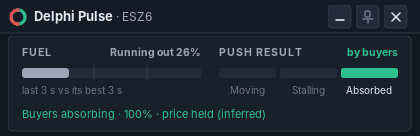
Rendered from a replay with sample prices, to explain how the add-on works. Not a trade result.
Learn about Delphi PulseMore order flow guides
What is absorption in order flow?
Absorption is when aggressive orders keep hitting a price and it does not move. Learn how to spot it, why it matters and how to tell it apart from a push that works.
How to read buyer and seller volume pressure
Volume pressure measures how much aggressive buying and selling is trading right now compared with normal. Learn what it shows, how to read it and where it misleads.
Sweeps and big lots in order flow
A sweep is an aggressive order that trades through several prices at once; a big lot is a single trade far larger than usual. Learn how to read both in futures order flow.
ES vs NQ: which index is leading?
ES and NQ usually move together, so it matters when one pushes and the other does not. Learn how to compare their order flow and read which index started first.
Reading ES order flow for SPX 0DTE options
SPX has no order book of its own, but ES futures do. Learn how SPX 0DTE options traders use ES order flow and how to convert ES prices to SPX levels.
This guide is for educational purposes only, about how markets trade and how an analysis tool displays it. It is not financial advice and does not recommend buying or selling any futures or options contract. Trading futures and options involves substantial risk, and losses can exceed the amount committed. See the Terms of Service.